Anatoli Boukreev—G. Weston DeWalt collaboration
The ClimbAnatoli Boukreev—G. Weston DeWalt collaboration was a joint effort to tell Boukreev’s personal story after the Everest tragedy, and it became a bond of trust with consequences beyond the writing itself. Their plan was made amid the work of preparing The Climb; their repeated agreement that DeWalt would finish the book if Boukreev did not return transformed collaboration into a promise DeWalt later understood as an obligation to answer public criticism.
The book takes shape
In the months immediately after the Everest tragedy, Boukreev and DeWalt met almost every day to discuss the book they planned to write. Their routine accommodated two kinds of work: they often began early, leaving Boukreev his afternoons to train and run in the Sangre de Cristo Mountains of northern New Mexico. The writing partnership was thus established alongside, rather than instead of, the physical discipline that continued to organize Boukreev’s life.
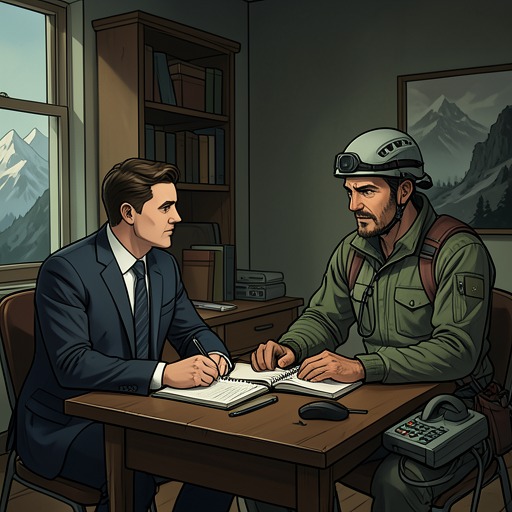
One morning, as Boukreev prepared to leave Santa Fe for expeditions to Cho Oyu and Shisha Pangma, the two men divided the tasks to be done while he was away. DeWalt read from his notes a list of work Boukreev had agreed to complete. Boukreev sat silently with his tea, his expression unreadable, while DeWalt repeated the list more slowly, supposing he might not have understood the English. He then leaned across the kitchen table and told DeWalt, “If I come back, you will have this. If I don’t, you must to do it.” The exchange made the book’s completion contingent on Boukreev’s return, and placed responsibility for any unfinished work with his coauthor.
A repeated promise and a published book
The kitchen-table exchange was not a one-time arrangement. Three times during their work on The Climb, Boukreev departed Santa Fe for expeditions, and each time the two men agreed that DeWalt would finish whatever remained if Boukreev did not come back. The possibility of death in the mountains therefore entered their writing process as a practical contingency, stated plainly and renewed with each departure.
The Climb was published in late October 1997. Almost immediately, St. Martin’s Press arranged a book tour, and the coauthors began traveling together. The schedule ran from early morning to midnight; Boukreev chafed because it interfered with his training, but accepted the demands with the same lack of complaint that DeWalt associated with his approach to climbing. Their collaboration had moved from the private routine of planning and drafting into public promotion, while the costs of that transition were most visible in the training time Boukreev lost.
DeWalt’s role after Boukreev’s death
When criticism of The Climb arose, DeWalt took on a further role as its respondent. In December 1997, while Boukreev was at Annapurna I Base Camp and out of communication, DeWalt prepared and mailed a paragraph-by-paragraph answer to charges in Jon Krakauer’s letter, sending Krakauer a copy. He contested, among other claims, the allegation that he had not tried to interview Neal Beidleman, offering documentary proof that he had faxed Beidleman a quotation from the Everest Base Camp debriefing tape in which Beidleman supported Boukreev’s having descended ahead of the Mountain Madness clients. The dispute made the book’s evidentiary record part of the partnership’s public aftermath.
After reading the postscript to the 1998 illustrated edition of Into Thin Air, DeWalt concluded that Krakauer continued to present what he regarded as a seriously flawed and misleading characterization of Boukreev. DeWalt’s objection was not that the postscript failed to acknowledge every part of Boukreev’s work: it did recognize his exceptional high-altitude skill and his rescue of Mountain Madness climbers, including Sandy Hill Pittman and Charlotte Fox. Rather, DeWalt objected to what he saw as the postscript’s continued critical framing and its repetition of complaints he believed had already been addressed. He also noted that it did not mention Boukreev’s recognition by the American Alpine Club for his actions on Everest.
DeWalt initially considered ignoring the postscript, but reread it and decided that silence would betray the trust Boukreev had placed in him. He connected that decision to their earlier agreement: if Boukreev did not come home, DeWalt would do what remained necessary. The promise had first concerned unfinished book tasks; in DeWalt’s later account, it also required him to defend the story the two had worked to tell.
Meaning of the collaboration
DeWalt described Boukreev as a person capable of sacrificing himself and his way of life, and said he was honored to have collaborated in telling his personal story. His remembrance joins the practical record of their work—the near-daily meetings, divided tasks, departures, and public tour—to an account of personal loss. The repeated promise gave the partnership a structure that survived its original circumstances: Boukreev’s absence turned a shared project into a responsibility carried by DeWalt alone.
The collaboration therefore continued in two forms. The Climb preserved the story they had set out to tell together; DeWalt’s later correspondence and response to Krakauer’s postscript extended the work into a dispute over how Boukreev’s actions should be understood. DeWalt framed that defense not simply as disagreement between authors, but as the fulfillment of a promise made before the outcome was known.